
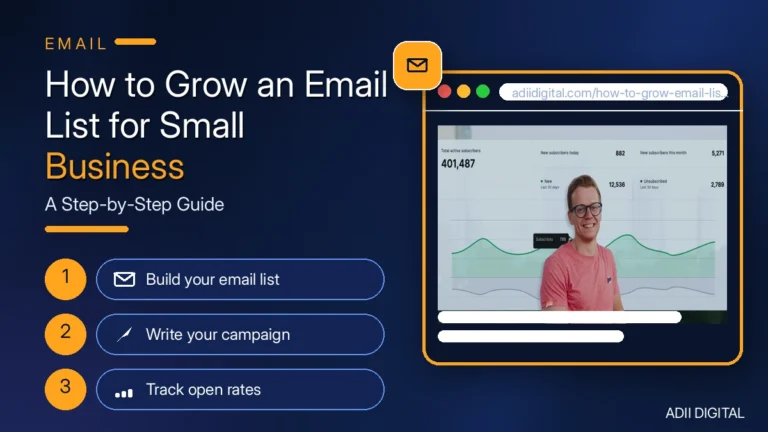
To grow an email list for your small business, offer a free lead magnet (a discount, guide, or checklist) in exchange for email addresses, add signup forms and popups to your website, promote your list on social media, and collect emails in person at checkout or events. Start with one good signup form and one good freebie — with steady effort, your list can grow month by month.
That is the whole strategy. No tricks, no bought lists, no spam. Below is every step in plain English, with practical steps for small businesses in 2026.
In This Article
- Why Does Email List Building Matter for Small Business?
- Step 1: Pick an Email Tool First
- Step 2: Create One Good Lead Magnet
- Step 3: Put Signup Forms Where People See Them
- Step 4: Promote Your List on Social Media
- Step 5: Collect Emails In Person
- Step 6: Send a Welcome Email Immediately
- What NOT to Do When Building an Email List
- How Long Does It Take to Grow an Email List?
- Frequently Asked Questions
- How many emails should I send to my list?
- What is a good email open rate for a small business?
- Do I need a website to build an email list?
- Is it legal to email my customers?
- How do I keep subscribers from unsubscribing?
- Start Growing Your List This Week
Why Does Email List Building Matter for Small Business?
Because email is the one marketing channel you truly own.
Social media followers are rented. A platform can change its algorithm overnight and your reach disappears. But an email list is yours. Nobody can take it away. When you send an email, it lands in your subscribers’ inboxes — people who chose to hear from you.
For a small business, this matters even more. Email marketing can be a cost-effective channel for a small business, and it costs almost nothing once your list is built. A restaurant can fill tables on a slow Tuesday with one email. An online shop can recover abandoned carts automatically. A service business can stay in touch with past customers and get repeat bookings.
The hard part is not sending emails. It is building the list in the first place. That is what this guide solves.
Step 1: Pick an Email Tool First
Before you collect a single address, you need somewhere to put them. An email marketing tool stores your subscribers, sends your emails, and handles the legal stuff like unsubscribe links automatically.
Good beginner-friendly options as of 2026:
- Brevo (formerly Sendinblue) — free plan with generous daily sending limits. Good for small lists.
- Mailchimp — widely known, free for small lists, easy signup forms.
- Kit (formerly ConvertKit) — built for creators and small businesses, clean and simple.
- MailerLite — affordable paid plans, easy to use.
Most of these have free plans for small lists, and paid plans that scale as your list grows. Prices change, so check the official site before you commit. Start free. Upgrade when your list outgrows it.
Pick one, create your account, and you are ready for Step 2.
Step 2: Create One Good Lead Magnet
A lead magnet is a freebie you give away in exchange for an email address. It is the engine of list building. Without one, almost nobody signs up.
The best lead magnets for small businesses are simple and specific:
- A discount code — “Get 10% off your first order.” Works for almost any shop or service.
- A short guide or checklist — “The 10-Point Home Plumbing Checklist.” Works for service businesses.
- A free sample or template — a free design template, a sample workout plan, a menu tasting.
- A quiz or assessment — “What’s your skin type?” with results by email. Fun and high-converting.
- Early access or a waitlist — for launches, new products, or limited services.
The rules of a good lead magnet: it must be useful, it must be quick to consume (5–10 minutes max), and it must match what you actually sell. A bakery offering a free cake-tasting coupon will build a list of cake buyers. A bakery offering a free generic eBook will build a list of nobody-in-particular.
Make one. Make it good. Everything else in this guide points to it.
Step 3: Put Signup Forms Where People See Them
Now put your offer in front of visitors. You need signup forms in the right places:
- Your homepage — a clear section or banner: “Get 10% off your first order — join our email list.” This is your most-visited page. Use it.
- Your blog posts — add a signup box at the end of every article. Readers who finished your post are your warmest prospects.
- A popup (done right) — an exit-intent or timed popup offering your lead magnet. Popups can convert well, as long as they are easy to close and do not appear in the first 3 seconds.
- Your checkout page — add a simple checkbox: “Send me deals and updates.” People buying from you are your best future subscribers.
- Your website footer — a small signup form on every page catches people who browse without buying.
Keep every form short. Email address only — maybe first name if you want to personalize. Every extra field you add can lower your signup rate. The less you ask, the more you get.
Step 4: Promote Your List on Social Media
Your social media followers are a ready-made audience. Turn them into email subscribers:
- Pin a signup post to the top of your Facebook page or Instagram profile link.
- Put the signup link in your bio on every platform. Use your link-in-bio tool to feature it.
- Talk about your lead magnet in posts. “Want our free wedding planning checklist? Link in bio.” Every few weeks, mention it again.
- Run a simple giveaway — “Enter your email for a chance to win [your product].” Giveaways grow lists fast. Just make sure the prize matches what you sell, or you will collect freebie-hunters who never buy.
Do not just post the link once and forget it. Mention your email list regularly — it is one of the few things on social media that actually moves your business forward long-term.
Step 5: Collect Emails In Person
If you have a physical location or meet customers face to face, this is a strong opportunity. In-person signups can convert well because the customer already trusts you.
- At checkout — ask every customer: “Want 10% off your next visit? Give me your email and I will send the code.” A tablet with a signup form makes this easy.
- A QR code at the counter — customers scan it and land on your signup page. Print it on a small sign with your offer.
- At events and markets — a simple paper signup sheet or tablet at your stall. Events are list-building goldmines.
- On receipts and business cards — add your signup link or QR code.
Train your staff to ask. A simple “Want to join our email list for 10% off next time?” takes five seconds and works remarkably well.
Step 6: Send a Welcome Email Immediately
Growing the list is only half the job. What you do next decides whether subscribers stay or unsubscribe.
Set up an automatic welcome email that sends the moment someone joins. It should:
- Deliver the promised freebie — the discount code, the guide, the checklist. Immediately. No waiting.
- Introduce your business — who you are, what you do, what kind of emails they will get.
- Set expectations — “I send one email a week with deals and tips.” People stay subscribed when they know what is coming.
Most email tools let you set this up in a few minutes with an automation or “welcome series.” Do it before you start promoting your list. A subscriber who gets nothing after signing up will forget you — or worse, mark you as spam later.
What NOT to Do When Building an Email List
This part is important. Bad list-building can hurt your business:
- Never buy an email list. Bought lists are full of dead addresses and people who never asked to hear from you. You will get spam complaints, your emails will land in spam folders, and you can violate anti-spam laws. It is never worth it.
- Never add people without permission. Do not import your entire contact list or add customers who never agreed to marketing emails. Every subscriber must opt in.
- Do not hide the unsubscribe link. It is legally required, and making it hard to leave just earns you spam complaints instead.
- Do not email too often at first. Start with one email a week. You can increase later once subscribers expect it.
Real subscribers, earned honestly. That is the only list that works.
How Long Does It Take to Grow an Email List?
Be honest with yourself: list building is slow at first, then it compounds.
Growth varies widely by business, traffic, and offer, so treat this as a rough illustration of how growth can build over time, not a promise:
- Month 1–2: early signups, mostly from your website and in-person signups.
- Month 3–6: growth picks up as your forms, social promotion, and content start working together.
- Month 6–12: steadier growth, mostly on autopilot.
The businesses that grow the fastest are the ones with the best lead magnet and the most visible signup forms. Quality beats tricks, every time. And remember: 500 engaged subscribers who open your emails beat 5,000 cold ones who do not.
Frequently Asked Questions
How many emails should I send to my list?
Start with one per week. That is enough to stay in touch without annoying people. You can increase to two or three per week during launches or sales, but consistency matters more than frequency.
What is a good email open rate for a small business?
For small business lists, what counts as a healthy open rate varies by industry and audience. If yours is much lower, check your subject lines and whether your list is full of real, engaged subscribers. Small, honest lists almost always outperform big, cold ones.
Do I need a website to build an email list?
It helps a lot, but it is not strictly required. You can collect emails in person, through social media links, and at events using just your email tool’s hosted signup page. But a website gives you a permanent home for your signup forms and lead magnet, and it makes everything work better.
Is it legal to email my customers?
Only if they agreed to receive marketing emails. A purchase alone does not always count as permission, depending on your country’s laws. Always get clear opt-in — a checkbox at checkout or a signup form — and always include an unsubscribe link. When in doubt, check your local email marketing rules.
How do I keep subscribers from unsubscribing?
Send emails people actually want: useful tips, real deals, behind-the-scenes stories. Keep a consistent schedule so they remember who you are. And clean your list regularly — remove subscribers who never open anything. A smaller, engaged list beats a big, dead one.
Start Growing Your List This Week
Here is your action plan, in order:
- Sign up for a free email tool today.
- Create one simple lead magnet this week.
- Add a signup form to your homepage and one popup.
- Set up your welcome email.
- Start asking customers in person and mentioning your list on social media.
Do those five things and your list will grow. Slowly at first, then steadily. A year from now, you will have an asset no algorithm can take away — a direct line to your customers.
Want help building your email list and marketing? We help small businesses with email marketing — list building, welcome sequences, newsletters, and campaigns that actually bring in sales. See our email marketing services →