
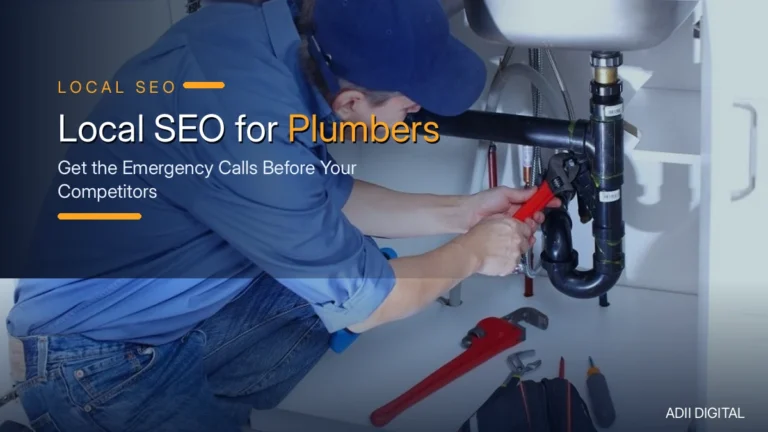
Local SEO for plumbers means making sure your business shows up first when someone nearby searches for a plumber — especially for urgent jobs like burst pipes and blocked drains. The plumber at the top of Google Maps usually gets the call first. This guide shows you how to be that plumber.
Give this five minutes and you’ll know exactly what to fix on your Google Business Profile, how to get reviews that win emergency calls, and which pages your website needs to outrank the competition.
In This Article
- Why Local SEO for Plumbers Matters More Than Other Marketing
- Local SEO for Plumbers Starts With Your Google Business Profile
- Reviews: The Emergency-Call Decision Maker
- Build Service Pages for Every Job and Every Area
- Get Listed Where Plumbing Customers Actually Look
- Make Your Website Convert Panicked Visitors
- Track Which Calls Actually Come From Google
- Frequently Asked Questions
- How much does plumber SEO cost?
- How long does SEO for plumbing companies take to work?
- Should plumbers run Google Ads too?
- What are the best plumbing SEO services to look for?
- Do I need a separate page for every city I serve?
- Ready to Own Your Local Market?
Why Local SEO for Plumbers Matters More Than Other Marketing
Nobody bookmarks a plumber’s website. When a pipe bursts at 11 PM, people grab their phone and search “plumber near me” or “emergency plumber.” They call the first business that looks trustworthy. They don’t scroll to page two.
That makes local search one of the most valuable marketing channels for many plumbing companies. A single emergency job can be worth hundreds, and the customers who find you in a crisis often become repeat customers for life. Plumber SEO isn’t about vanity rankings — it’s about being the obvious choice in the moment of panic.
Local SEO for Plumbers Starts With Your Google Business Profile
For plumbers, your Google Business Profile (the listing that shows up on Google Maps) matters more than your website. If you work from home or a yard rather than a shopfront, it helps to know how a service-area setup differs from a storefront listing. It’s what shows the map pack — those top three results with the call button. Here’s how to make yours win:
- Pick the right primary category. “Plumber” should be your primary category. You can add secondary ones like “Drainage service” or “Water heater repair service” if you genuinely offer them.
- List every service you offer. GBP lets you add services under each category. Add them all: drain cleaning, water heater installation, leak detection, sewer line repair, fixture installation, and so on. Each one is a chance to match a search.
- Set your service area correctly. Most plumbers serve customers at their homes, so define the towns and neighborhoods you cover. Don’t claim a 100-mile radius you can’t actually serve — it hurts more than it helps.
- Add real photos. Your vans, your team, before-and-after shots of jobs (with permission). Profiles with real photos tend to earn more trust — and more calls — than stock-photo profiles.
- Use the booking or quote link. If you take online bookings or quote requests, link them. Every bit of friction you remove wins you jobs.
- Post updates. A quick weekly post — “Now offering trenchless sewer repair in [Town]” — keeps the profile active and can surface for related searches.
Define it plainly: the map pack is the block of three local business listings Google shows at the top of local searches, with a map. Ranking in it is the whole game for emergency trades.
Reviews: The Emergency-Call Decision Maker
When someone’s basement is flooding, they pick the plumber with the most convincing reviews. Not the cheapest — the most trustworthy. Our guide to online reviews for plumbers covers this in depth, including how to get more Google reviews without awkward asks. Here’s what works for plumbing companies:
- Ask at the right moment. Right after you fix the problem, when the customer is relieved and grateful. A simple “Would you mind leaving us a quick Google review? It really helps our small business” works.
- Make it stupid-easy. Text or email a direct link to your Google review page. Every extra click loses reviews.
- Respond to every review. Thank the happy customers. For bad reviews, respond calmly and professionally — future customers read your responses as closely as the reviews themselves.
- Aim for steady, not sudden. A flood of 30 reviews in one week looks suspicious. A few every week looks natural, because it is.
Reviews also feed the algorithm. Plumbers with more recent, positive reviews tend to rank better than competitors with stale profiles.
Build Service Pages for Every Job and Every Area
Your website needs a page for each major service you offer, and ideally for each service in each area you serve. This is where most plumber websites fall short — they have one generic “Services” page and wonder why they don’t rank.
What to build:
- One page per core service: “Drain Cleaning in [City],” “Water Heater Installation in [City],” “Emergency Plumber in [City].”
- Real, useful content on each page. Describe the service, common problems, your process, and pricing guidance in honest general terms. This is also where content marketing for plumbers pays off — helpful articles that answer real customer questions. Thin pages with 100 words of fluff don’t rank.
- Click-to-call everywhere. Your phone number should be tappable on every page, especially on mobile. Most plumbing searches happen on phones.
- An emergency banner. A visible “24/7 Emergency Service — Call Now” element on every page. If you genuinely offer round-the-clock service, say so loudly.
Each page should answer the customer’s question completely: what the service is, when they need it, what you’ll do, and how to reach you right now.
Get Listed Where Plumbing Customers Actually Look
Citations — mentions of your business name, address, and phone number on other websites — still matter for local rankings. For plumbers, focus on the directories your customers actually use:
- The big general ones: Yelp, Bing Places, Apple Maps, Facebook.
- Trade-specific directories: Angi, HomeAdvisor, Thumbtack, and your local Better Business Bureau.
- Local directories: your chamber of commerce and any city business listings.
Keep your name, address, and phone number identical everywhere. “Mike’s Plumbing LLC” on one site and “Mike’s Plumbing” on another creates confusion that can cost you rankings. This consistency work is boring, but it’s the foundation everything else sits on. Work through it alongside a local SEO checklist so nothing gets missed.
Make Your Website Convert Panicked Visitors
Ranking is only half the job. When someone lands on your site mid-emergency, they decide in seconds. See our website design guide for plumbers for the full breakdown of what a high-converting plumbing site needs:
- Phone number in the header, big and tappable on mobile.
- “Emergency?” messaging above the fold. Speak their language: “Burst pipe? We’ll be there within the hour.”
- Trust signals fast. License info, years in business, review stars, real photos of your team — not stock photos of models holding wrenches.
- Simple quote forms. Name, phone, problem, address. That’s it. Long forms get abandoned.
- Fast loading. A slow site on a phone with one bar of signal loses the job. Compress images and keep pages lean.
Track Which Calls Actually Come From Google
If you can’t measure it, you can’t improve it. Call tracking is one piece of a wider lead generation system for plumbers. At minimum:
- Use call tracking numbers on your GBP listing and website so you know which calls came from search.
- Ask every caller how they found you, and log it.
- Check your GBP insights monthly. Google shows you how many people called, requested directions, or visited your website from your listing.
Plumbers who track their calls often discover Google drives more business than they expected — which can make investing in it an easier decision.
Frequently Asked Questions
How much does plumber SEO cost?
It depends on your market and competition, but many plumbing companies invest in ongoing monthly SEO rather than one-time fixes. Competitive metro areas cost more than small towns. What matters more than the price is whether the work targets emergency and high-value job keywords — that’s where the return comes from.
How long does SEO for plumbing companies take to work?
Google Business Profile improvements — categories, services, photos, reviews — can move the needle within weeks. Website rankings for competitive terms like “plumber [city]” typically take a few months of consistent work. Anyone promising page one in a week is selling something that doesn’t exist.
Should plumbers run Google Ads too?
Ads can fill the gap while SEO builds up, especially for emergency keywords. See our guide to Google Ads for plumbers for targeting and budget advice. Many plumbing companies run both: ads for immediate calls, SEO for long-term visibility that doesn’t cost per click. If your budget only covers one, start with whichever your competitors are weakest at.
What are the best plumbing SEO services to look for?
Look for providers who understand the trade: GBP optimization, review generation systems, service-area page builds, and call tracking. Ask to see examples of trade businesses they’ve worked with, and be wary of anyone who can’t explain their process in plain English.
Do I need a separate page for every city I serve?
If you genuinely serve those cities, yes — one honest, useful page per service area beats one generic page trying to rank everywhere. Don’t create pages for towns you’ve never worked in. Google and customers both see through it.
Ready to Own Your Local Market?
Emergency calls go to the plumber Google trusts most. If you’d rather have a team that knows the plumbing trade handle your rankings, reviews, and service pages, Get a Plumber SEO Audit — we’ll show you exactly where you stand against your local competitors and what it’ll take to pass them.