
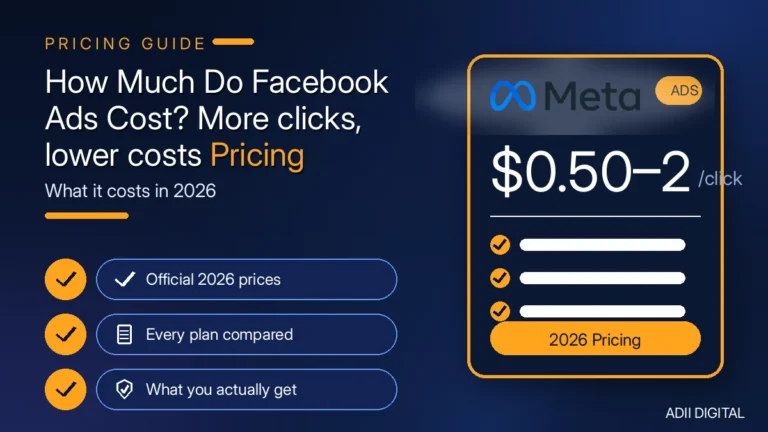
Facebook ads cost roughly $0.50 to $2 per click and about $8 to $15 per thousand impressions (CPM), based on widely cited ranges — but actual costs vary widely by audience, industry, and ad quality. Many small businesses start with monthly budgets in the $200 to $1,000 range. Your real cost depends on your audience, your industry, and how good your ads are at stopping the scroll.
In This Article
- How Does Facebook Ad Pricing Actually Work?
- What Are the Average Facebook Ads CPC and CPM Ranges?
- What Makes Facebook Ads More Expensive?
- How Much Should a Small Business Spend on Facebook Ads?
- How Can You Lower Your Facebook Ad Costs?
- Should You Boost Posts or Use Ads Manager?
- When Does Hiring a Facebook Ads Manager Make Sense?
- Frequently Asked Questions
- What is the minimum budget for Facebook ads?
- Why did my Facebook ad costs suddenly spike?
- Are Facebook ads cheaper than Google ads?
- Do Facebook ads still work in 2026?
- How long should I run a Facebook ad before judging it?
- Related Guides
Those ranges are wide, because Facebook ad pricing works differently from Google. On Google, people search with intent. On Facebook, you’re interrupting someone’s feed. That makes your creative — the image, the video, the first line of copy — a bigger price lever than almost anything else.
How Does Facebook Ad Pricing Actually Work?
Facebook runs an auction, just like Google, but the bidding feels different. You’re not bidding on keywords. You’re bidding for a spot in someone’s feed, and you’re competing with every other advertiser targeting the same kind of person.
Three things decide what you pay:
- Your bid and budget: how much you’re willing to spend per result.
- Estimated action rates: Facebook predicts how likely people are to engage with your ad. Ads people interact with get cheaper placement.
- Ad quality and relevance: Facebook scores your ad. Higher scores mean lower costs and more delivery.
The big insight: a great ad can cost half as much as a mediocre ad to reach the same people. Creative quality is a discount code on Facebook.
What Are the Average Facebook Ads CPC and CPM Ranges?
Widely cited industry benchmarks give a rough picture of where prices sit. Treat these as broad ranges, not guarantees — your costs can fall well outside them — and note that they shift with the economy, the season, and platform changes.
- Average cost per click (CPC): roughly $0.50 to $2 across most industries.
- Average cost per thousand impressions (CPM): roughly $8 to $15.
- Average cost per lead: varies widely by industry; widely cited ranges for service businesses are commonly around $10 to $30.
By industry, rough, widely cited CPC ranges look like this (again, your actual costs can vary widely):
- Apparel and retail: among the cheapest, often $0.30 to $0.80 per click.
- Food and restaurants: usually $0.40 to $1 per click.
- Beauty and fitness: around $0.80 to $1.50 per click.
- Real estate: around $1 to $2.50 per click.
- Finance and insurance: among the priciest, often $2 to $4 per click.
- B2B services: around $1.50 to $3 per click.
And CPMs follow the same logic: broad consumer audiences are cheap to reach, while narrow professional or high-income audiences cost more because more advertisers want them.
What Makes Facebook Ads More Expensive?
If your costs are climbing, one of these is usually the culprit:
- Narrow targeting: targeting a tiny audience (say, 10,000 people) drives up CPMs because the auction is crowded and the pool is small. Broader audiences are often cheaper.
- Ad fatigue: showing the same ad to the same people for weeks. Frequency climbs, engagement drops, costs rise. Refresh creative every few weeks.
- Poor creative: boring stock photos and generic copy get ignored. Facebook notices the low engagement and charges you more for the same reach.
- Wrong objective: running a traffic campaign when you want sales confuses the algorithm. Match your campaign objective to your actual goal.
- Seasonality: the fourth quarter (holiday season) is the most expensive time to advertise on Facebook. January is often the cheapest.
- Placements: automatic placements usually find the cheapest inventory across Facebook, Instagram, and Audience Network. Limiting yourself to one placement can raise costs.
- Landing page friction: if people click but bounce immediately, Facebook learns your ad experience is poor and your costs drift up.
How Much Should a Small Business Spend on Facebook Ads?
There’s no official minimum, but practical minimums exist. Here’s a realistic framework:
- Testing phase ($10 to $20 a day): enough to test two or three ad variations against one audience for a week or two.
- Learning phase ($500 to $1,000 a month): the minimum most small businesses need to get reliable data and let Facebook’s algorithm optimize.
- Scaling phase ($1,000+ a month): once you know your cost per lead or sale, you can scale the winners.
A useful rule: don’t spend money you can’t afford to treat as tuition for the first 30 days. Almost nobody’s first Facebook campaign is profitable. The winners are the ones who test, read the numbers, and double down on what works.
To set your own budget, work backward from your numbers:
- What is a customer worth to you?
- What can you afford to pay for a lead?
- Divide your affordable cost per lead by your expected cost per click to see how many clicks your budget buys.
How Can You Lower Your Facebook Ad Costs?
Unlike Google, where Quality Score does the heavy lifting, Facebook rewards creative and audience fit. Here’s what actually moves the needle:
- Make better creative. This is number one by a mile. Real photos and short videos of your actual business beat polished stock images. User-style content — filmed on a phone, casual, honest — often performs well compared with slick corporate ads.
- Test hooks, not just images. The first three seconds of a video or the first line of copy decide everything. Test five different openings for the same offer.
- Broaden your audience. Unless you have a very specific reason to go narrow, let Facebook’s algorithm find buyers inside a bigger pool. Broad targeting with good creative often beats hyper-targeting.
- Use video. Video ads often earn more engagement than static images, which pushes your relevance up and your costs down.
- Refresh creative regularly. Watch your frequency metric. When the same people keep seeing the same ad, swap in something new.
- Simplify your funnel. Send clicks to a fast, mobile-friendly page with one clear action. Every extra step between click and conversion costs you money.
- Retarget warm audiences. People who visited your site or watched your videos are cheaper to convert than cold strangers. Always run retargeting alongside cold campaigns.
Should You Boost Posts or Use Ads Manager?
Short answer: use Ads Manager. Boosting a post is fine for getting a few extra eyeballs on an announcement, but it’s a blunt tool. Ads Manager gives you proper objectives, real targeting, A/B testing, and honest reporting.
If you’ve been boosting posts and wondering why the results are fuzzy, that’s why. The boost button is Facebook’s easiest product to sell, not its most effective product to use.
When Does Hiring a Facebook Ads Manager Make Sense?
If you’re spending over $1,000 a month, professional management can pay for itself through lower costs and better creative testing. A good manager runs structured tests, kills losers fast, and reports in numbers you can understand — cost per lead, cost per sale, return on ad spend.
Watch out for anyone who promises specific results or talks only about likes and reach. You want someone obsessed with your cost per customer.
Frequently Asked Questions
What is the minimum budget for Facebook ads?
Technically $1 a day. Realistically, $10 to $20 a day is the smallest budget that produces usable test data. Below that, results are too thin to learn from.
Why did my Facebook ad costs suddenly spike?
Usually ad fatigue (same creative, same audience, too long), a seasonal demand surge (like the holidays), or a recent change you made that reset the learning phase. Check your frequency first — if it’s climbing past 3 or 4, refresh your creative.
Are Facebook ads cheaper than Google ads?
Per click, usually yes. Facebook CPCs tend to run lower than Google Search CPCs in most industries. But the comparison is misleading: Google clicks come with buying intent, while Facebook clicks need more nurturing. Compare cost per customer, not cost per click.
Do Facebook ads still work in 2026?
Yes. The platform has changed — privacy updates made targeting less precise than it used to be — but advertisers who lean into strong creative and broad targeting still get solid returns. The playbook changed; the opportunity didn’t disappear.
How long should I run a Facebook ad before judging it?
Give a new ad set at least 3 to 5 days and enough budget to get 50 or so optimization events (clicks, leads, or purchases depending on your objective) before making big decisions. Judging after one day is like tasting soup before it’s done cooking.
Related Guides
- Social Media Marketing for Small Business 2026: The Plain-English Playbook
- Instagram Marketing for Small Business: 12 Practical Tips (2026)
- How Much Does SEO Cost Per Month for Small Business?
- How to Automate Lead Generation with AI: A Step-by-Step Guide
- Top 10 Digital Marketing Strategies for Small Businesses in 2026
- Digital Marketing Strategy Example: Step-by-Step Plan for Success
- Best AI Tools for Lead Generation in 2026 (9 Honest Picks)
Facebook ads can be an affordable way to put your business in front of thousands of the right people — if the creative is strong and the budget is honest. If you’d rather have an experienced hand running your campaigns, take a look at our digital marketing services — we offer flat-fee Facebook ad management with clear reporting on what every dollar does.