
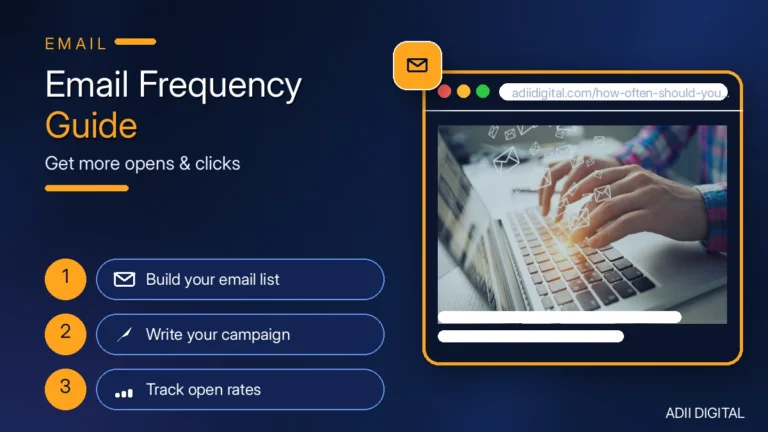
For most businesses, one to three marketing emails per week is a safe starting point. Ecommerce brands with fresh offers often do well at two to four per week, B2B companies usually land around one to two, and SaaS businesses sit somewhere in the middle. The right number depends on your audience, your content, and how engaged your list is — there is no magic number that works for everyone.
In This Article
- What’s a Good Starting Point for Email Frequency?
- How Do You Know You’re Sending Too Many Emails?
- How Do You Test the Right Cadence?
- Should Different Segments Get Different Frequencies?
- What About Promotional vs. Educational Emails?
- Frequently Asked Questions
- Is sending daily emails too much?
- Will sending more emails hurt my deliverability?
- How often should a small business send emails?
- Should I email on weekends?
- What if my list prefers less email than my competitors send?
Ask ten marketers this question and you’ll get ten different answers. Some swear by daily emails. Others say anything more than monthly is too much. The truth is less exciting: it depends. But “it depends” isn’t helpful on its own, so let’s get specific about what works for different business types and how to find your own sweet spot. If you are still building the foundations, start with our guide on what email marketing is.
What’s a Good Starting Point for Email Frequency?
If you’re just starting out or revamping your program, begin here and adjust based on what your numbers tell you. These starting points sit inside a wider email marketing strategy, so revisit the plan as your list grows:
- Ecommerce: 2-4 emails per week. Shoppers expect regular deals, new arrivals, and reminders. Your list signed up for offers, so offers are the deal.
- B2B / professional services: 1-2 emails per week. Your audience is busy and your content is usually educational. One strong weekly email beats three thin ones.
- SaaS / software: 1-3 emails per week, split between product updates and educational content. Users want to know what’s new and how to get more from the tool.
- Content creators / newsletters: 1 email per week is the classic rhythm. Some go daily, but only if every issue genuinely delivers.
- Local businesses (restaurants, salons, gyms): 2-4 emails per month. Your customers like hearing from you, but weekly emails about the same menu get old fast.
These are starting points, not rules. A daily-deals site can email twice a day and thrive. A high-end consultant might email twice a month and do just fine. The pattern that matters: consistency beats volume.
How Do You Know You’re Sending Too Many Emails?
Your subscribers will tell you — not in words, but in metrics. Watch for these warning signs:
- Unsubscribe rate climbs. A few unsubscribes per send is normal. A sudden spike after you increased frequency is a clear signal.
- Spam complaints rise. This is the serious one. Even a small jump in “mark as spam” reports damages your sender reputation fast.
- Open and click rates slide. If engagement drops across the board after you send more, you’re training people to ignore you.
- Reply tone turns sour. If you get “please stop emailing me so much” replies, believe them.
On the flip side, here’s how you know you might be sending too few:
- Subscribers forget who you are. (“Who is this? I don’t remember signing up.”)
- Engagement is flat even though your content is good — you’re just not top of mind.
- Competitors are in your subscribers’ inboxes every week and you’re there once a month.
How Do You Test the Right Cadence?
Guessing is fine for a starting point, but testing is how you get confident. Here’s a simple way to do it:
- Pick a test window of 4-6 weeks. Shorter than that and you won’t have enough data; longer and you’ll lose patience.
- Split your list in half. Group A keeps your current frequency, Group B gets one extra (or one fewer) email per week. Keep the content quality the same.
- Track the metrics that matter: unsubscribes per 1,000 sends, spam complaints, revenue or conversions per subscriber, and overall engagement — not just open rate on individual emails.
- Compare totals, not averages. Sending twice as often with half the open rate can still win if total clicks and revenue go up without a complaint spike.
- Run the winner for another month before declaring victory. Email behavior has noise; one good week isn’t proof.
Many email marketing tools include split-testing features that make this kind of comparison easier. One more testing idea: ask your subscribers directly. A one-question survey (“How often would you like to hear from us?”) with three options — weekly, twice a month, monthly — gets surprisingly honest answers, and you can segment people by their preference.
Should Different Segments Get Different Frequencies?
Yes — this is where the real gains hide. Not everyone on your list wants the same cadence.
- Your most engaged readers (open most emails, click regularly) can usually handle more. They’re your VIPs — send them early access, extra tips, more frequent updates.
- New subscribers should get your welcome sequence first (daily or every-other-day for the first week), then settle into your normal rhythm.
- Quiet subscribers (haven’t opened in 60+ days) should get fewer emails, not more. Bombarding people who’ve tuned out just generates spam complaints. Send them a re-engagement email, then reduce or pause.
- Buyers vs. browsers: Customers who’ve purchased can get product-related emails more often. People who’ve never bought should get more educational content at a gentler pace.
Many email platforms can build these segments from opens, clicks, and purchase history. Set it up once and it keeps running. If you are choosing a tool, compare the best email marketing platforms for small businesses before you build your segments.
What About Promotional vs. Educational Emails?
The mix matters as much as the count, and it should line up with your wider content strategy. A common guideline many marketers use:
- 80/20 rule: Roughly 80% of your emails should educate, entertain, or help. About 20% should directly sell. When every email is a pitch, people tune out. When most emails are useful, the occasional pitch feels welcome.
- Batch your promos. Instead of sprinkling sales emails randomly, run focused promo periods (a launch week, a seasonal sale) and tell subscribers what’s coming. Context makes frequent emails feel intentional instead of spammy.
- Match frequency to your calendar. Ecommerce brands naturally email more around holidays. B2B companies might go quiet in late December. Let your business rhythm guide you instead of forcing a flat schedule all year.
Frequently Asked Questions
Is sending daily emails too much?
For most businesses, yes — daily emails burn out all but the most devoted audiences. The exceptions are daily-deal sites, news-style newsletters, and creators whose audience explicitly signed up for daily content. If you go daily, every single email has to earn its place.
Will sending more emails hurt my deliverability?
It can, if the extra emails go to unengaged people who ignore or report them. Volume alone isn’t the problem — sending more emails to people who want them is fine. Sending more to people who don’t is what gets you into spam folders.
How often should a small business send emails?
Start with twice a month and work up to weekly if your content stays strong and your metrics hold. Small businesses often do best with a consistent monthly or biweekly newsletter plus occasional announcements, rather than forcing a weekly schedule with thin content.
Should I email on weekends?
It depends on your audience. B2B emails generally perform better on weekdays, while ecommerce and lifestyle brands often see good weekend engagement when people are shopping and browsing. Test it with your own list rather than following a generic best practice.
What if my list prefers less email than my competitors send?
Follow your list, not your competitors. Every audience is different. If your subscribers engage best at twice a month, that’s your answer — even if a competitor emails daily. Your metrics are the only benchmark that matters.
The right email frequency is the one your subscribers actually want: start with one to three per week, segment by engagement, watch your unsubscribes and complaints, and test your way to the cadence that fits. If you’d rather skip the trial and error, and want email frequency set as part of a wider digital marketing strategy, our digital marketing services include managed email marketing built around your audience.