
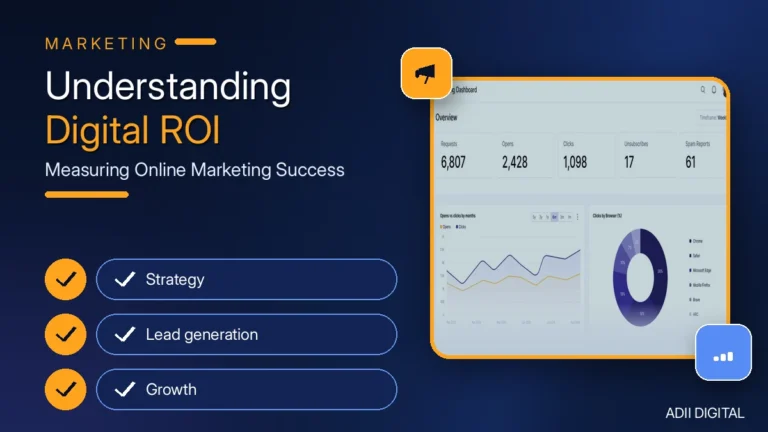
Digital ROI is the return on investment from your digital marketing. It is calculated as (revenue from marketing − marketing cost) ÷ marketing cost × 100. If you spend $1,000 on a campaign and it generates $5,000 in revenue, your digital ROI is 400%.
Tracking digital ROI matters because it separates marketing that drives sign-ups, sales, and revenue from marketing that just makes noise. When you know what each dollar earns, you can put more budget behind what works and cut what does not.
In This Article
- How to Measure Digital ROI: The Formula
- Why Targeted Content Improves Digital ROI
- Know Your Audience Before You Spend
- Get Your Content in Front of the Right People
- Use SEO to Raise Digital ROI
- Measure Whether Your Content Is Working
- Adjust Your Approach Based on the Numbers
- Lessons From Well-Known Campaigns
- Frequently Asked Questions
- What is a good digital ROI?
- How often should I measure digital ROI?
- What is the difference between ROI and ROAS?
- Can small businesses measure digital ROI without expensive tools?
- Conclusion: Key Takeaways for a Better Digital ROI
How to Measure Digital ROI: The Formula
Digital ROI has a simple formula:
ROI = (Revenue from marketing − Marketing cost) ÷ Marketing cost × 100
For example, if you spend $1,000 on ads and those ads generate $5,000 in revenue, your ROI is ($5,000 − $1,000) ÷ $1,000 × 100 = 400%. To measure it accurately, track three things: (1) total marketing spend per channel, (2) revenue attributed to each channel — use UTM parameters and conversion tracking in Google Analytics — and (3) customer lifetime value for longer sales cycles. Without these numbers, improving ROI is guesswork. With them, every tactic below becomes measurable.
Why Targeted Content Improves Digital ROI
Targeted content is content written for a specific audience instead of for everyone at once. The better you understand your audience, the more directly you can speak to their needs — and the more likely they are to take the next step, whether that is signing up, booking a call, or making a purchase.
Think of it this way: a store selling basketball gear would not show a fishing rod to a basketball player. Yet many businesses still send the same generic message to every visitor. Content that matches a reader’s interests and problems turns casual visitors into repeat buyers, while generic content gets ignored. That is why an effective content strategy starts with the audience, not the publishing calendar.
Know Your Audience Before You Spend
If you want to improve your digital ROI, start by building a clear picture of your ideal customer. Consider their age, occupation, location, interests, and the problems they are trying to solve. Are they busy parents short on time, or business owners looking for growth? Knowing these details helps you shape content that feels written for them.
Spray-and-pray content marketing — publishing anything and hoping something sticks — wastes budget. Content that addresses your audience’s pain points, interests, and goals earns attention, and attention is what turns into clicks, leads, and sales. Before you create anything, write down who it is for and what action you want them to take after reading it.
Get Your Content in Front of the Right People
Distribution deserves as much thought as creation. First, find out where your audience already spends time online — social media, email, forums, or search — and focus your distribution there. Then stay active: reply to comments, answer questions, and join the discussion around what you publish instead of posting and disappearing.
Collaborations can also widen your reach, especially with creators or businesses that serve the same audience. Focus on quality over quantity, and pay attention to when your audience is most active so your posts reach them at the right time. Finally, do not forget your existing content: updating and republishing older posts that still matter can bring in new traffic at almost no cost, and it is one of the simplest ways to increase your website traffic.
Use SEO to Raise Digital ROI
Search engine optimization helps your content reach people who are already looking for what you offer. When your articles rank for the terms your audience searches, you earn clicks without paying for each one — and those visitors arrive with clear intent, which is why SEO is one of the highest-leverage ways to improve ROI over time.
SEO is not a one-time task. Search engines reward fresh, relevant, well-structured content, so keep updating your pages and publishing genuinely useful material. Learn how keyword optimization powers content marketing, and build it into an SEO content strategy that targets the searches your buyers actually make. A site that is easy to find is a site that converts more of the traffic it already earns.
Measure Whether Your Content Is Working
To raise your digital marketing ROI, look at the numbers behind your content. Start with marketing analytics: page views, bounce rate, time on page, and engagement. Find out which pieces keep readers around and which ones lose them — and what readers do next after they finish.
Conversion rate is the number that matters most: how many readers take the action you wanted, whether that is filling out a form, subscribing, or buying. Review these metrics regularly, compare content pieces against each other, and treat weak results as information, not failure. Small adjustments — a clearer headline, a stronger call to action, a better-targeted topic — often turn an average post into a strong performer.
Adjust Your Approach Based on the Numbers
Improving ROI is a cycle, not a one-off project: measure, adjust, and measure again. A documented digital marketing strategy gives every adjustment a clear target to aim for. Here is what to review when the numbers say something is not working:
- Check the data first. Are you tracking the metrics that connect to revenue, or just vanity numbers like raw impressions?
- Re-examine the message. If your content does not resonate with your audience, change the angle, the offer, or the format.
- Revisit the audience. The better you understand their motivations and problems, the more relevant your content becomes.
- Try new formats. A video, a guide, or a different campaign style can reach people your blog posts never did — test one change at a time so you know what caused the improvement.
- Protect quality. Content that genuinely helps people builds an audience; volume alone does not.
Staying adaptable is the whole game. Markets shift, platforms change, and audience tastes move. The businesses that keep testing and refining are the ones that keep their ROI climbing.
Lessons From Well-Known Campaigns
Some widely discussed campaigns illustrate the same principles in action — audience focus, useful content, and a clear message:
- Old Spice rebuilt its image with humorous ads aimed squarely at a younger audience. The lesson: speak directly to the people you want to reach, in a voice they recognize.
- HubSpot built its reputation on educational content — guides, templates, and tools that help marketers and salespeople do their jobs. The lesson: teaching your audience is a durable way to earn trust.
- Airbnb leaned on real travel stories from hosts and guests rather than standard hotel-style advertising. The lesson: real stories can carry a brand message further than a sales pitch.
None of these examples guarantees the same outcome for your business. What they share is a disciplined focus on the audience and on content people actually want to consume.
Frequently Asked Questions
What is a good digital ROI?
There is no single benchmark that fits every business. A good ROI is one that is positive, repeatable, and improving over time after all costs — ad spend, tools, and time — are counted. Compare your ROI against your own past results and against similar businesses in your industry rather than chasing a universal number.
How often should I measure digital ROI?
Review channel-level ROI at least once a month so you can shift budget away from underperformers quickly. Campaign-level ROI can be checked weekly while a campaign is running, and a deeper review each quarter helps you spot trends that monthly snapshots miss.
What is the difference between ROI and ROAS?
ROI measures profit against total marketing cost, including tools, labor, and fees. ROAS (return on ad spend) measures revenue against ad spend only. ROAS is useful for judging a single ad campaign; ROI tells you whether your marketing as a whole is actually profitable.
Can small businesses measure digital ROI without expensive tools?
Yes. A spreadsheet, UTM parameters, conversion tracking in Google Analytics, and a record of what you spend per channel are enough to calculate ROI for most small businesses. The formula is the same whether you track it in a spreadsheet or an enterprise dashboard.
Conclusion: Key Takeaways for a Better Digital ROI
Improving digital ROI comes down to a repeatable process: know your audience, create content they need, make it easy to find with SEO, measure what happens, and adjust based on the numbers. Quality beats quantity, data beats guessing, and consistency beats one-off campaigns.
Start by checking the technical side of your own site — learn how to find SEO errors on your website — then apply the formula in this guide to your next campaign. Want help improving your marketing ROI? Explore our digital marketing services or contact Adii Digital.