
Retargeting is a form of online advertising that shows ads to people who have already visited your website or interacted with your brand. It uses a small tracking code, called a pixel, to identify those visitors and then displays relevant ads to them as they browse other websites, use social media, or watch videos. It can be a reliable way to bring lost visitors back.
In This Article
- How Does Retargeting Actually Work?
- What’s the Difference Between Retargeting and Remarketing?
- What Are the Main Types of Retargeting?
- Where Can You Run Retargeting Campaigns?
- How Much Does Retargeting Cost?
- What Makes a Retargeting Campaign Actually Work?
- What Are the Common Retargeting Mistakes?
- Is Retargeting Still Effective With Privacy Changes?
- Frequently Asked Questions
- How long should a retargeting cookie window be?
- Do I need a lot of website traffic to run retargeting?
- What’s the difference between a pixel and a tag?
- Can retargeting work for service businesses, not just e-commerce?
- How do I stop my retargeting ads from annoying people?
You’ve seen it happen. You look at a pair of shoes online, leave the site, and suddenly those same shoes follow you across Facebook, Instagram, and news sites for days. That’s retargeting. And despite how simple it sounds, it can be one of the more efficient tactics in paid advertising, because you’re talking to people who already showed interest instead of cold strangers.
How Does Retargeting Actually Work?
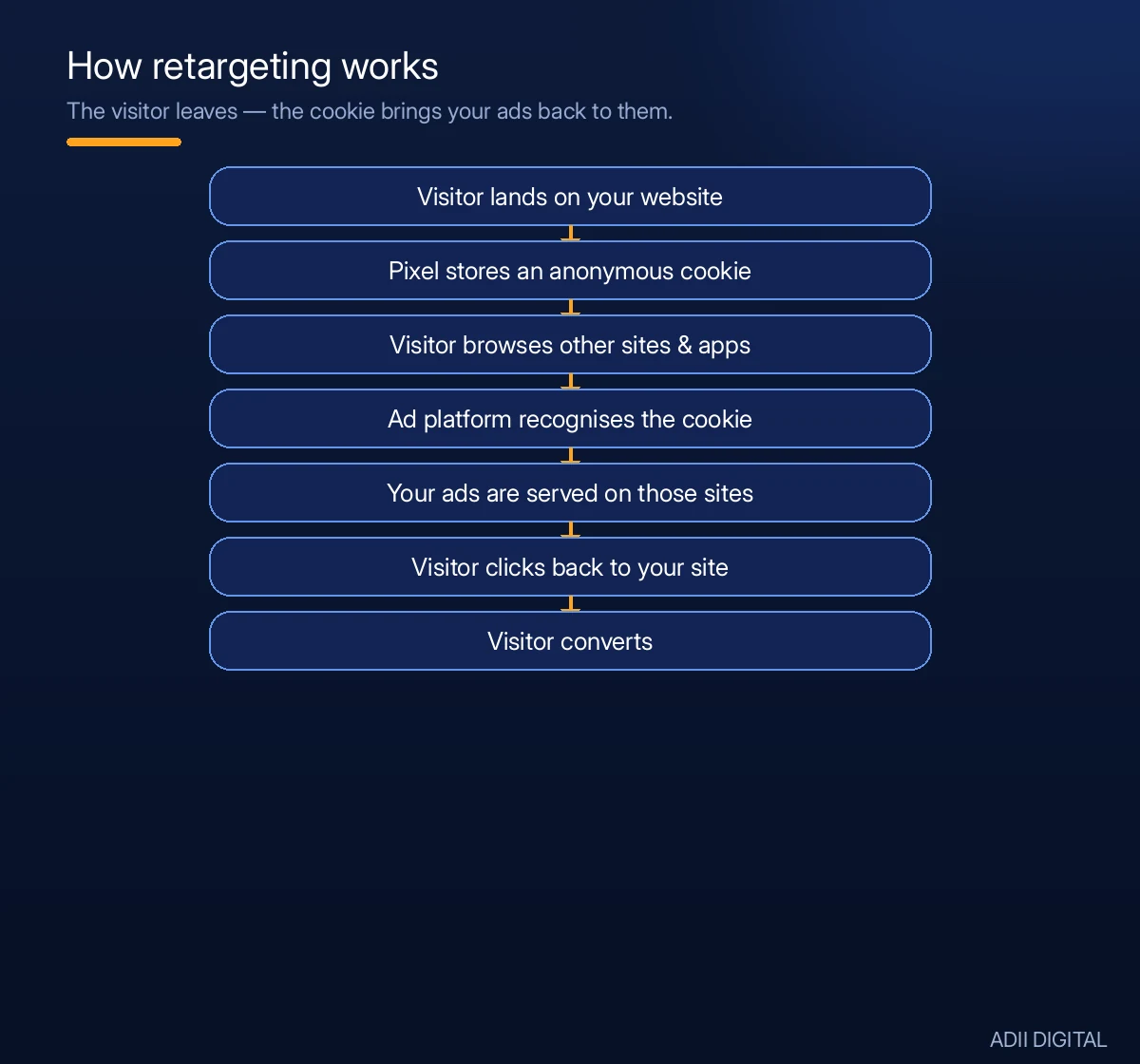
The mechanics are simpler than most guides make them sound. Here’s the basic flow:
- A visitor lands on your website.
- A tiny piece of code (the pixel) drops an anonymous browser cookie on their device.
- They leave your site and continue browsing.
- Your ad platform recognizes the cookie and serves them your ads on other sites and apps.
- The visitor clicks the ad, comes back, and (hopefully) converts.
No personal data changes hands. The pixel doesn’t know their name or email. It just knows “this browser visited your pricing page yesterday” and shows them ads accordingly. Most platforms let you set how long a visitor stays in your retargeting pool — anywhere from a few days to a year — through something called a membership duration or cookie window. If you run Google Ads, this Google Ads conversion tracking setup guide walks through the tagging side of it.
What’s the Difference Between Retargeting and Remarketing?
People use these two words interchangeably, but there’s a small technical difference worth knowing:
- Retargeting usually refers to online ads shown to past visitors through paid platforms like Google Ads or Facebook.
- Remarketing often refers to re-engaging people through email, like sending “you left items in your cart” messages to subscribers.
Google actually uses the term “remarketing” for its display retargeting product, which confuses things further. In practice, if you’re running ads to people who visited your site before, everyone will understand what you mean either way. Email-based re-engagement pairs well with a solid email marketing strategy.
What Are the Main Types of Retargeting?
Not all retargeting looks the same. Here are the main flavors you’ll run into:
Site retargeting. The classic version. Someone visits your site, and your ads follow them around the web. This is what most people mean when they say “retargeting.” For a step-by-step walkthrough, see how to set up Facebook retargeting ads.
Search retargeting. This targets people based on the keywords they’ve searched, even if they’ve never visited your site. You build audiences from search behavior rather than site visits.
Social media retargeting. Platforms like Facebook and Instagram let you retarget people who watched your videos, engaged with your posts, or visited your profile — no website visit required.
Email retargeting. You target your email list with ads. Upload your subscriber list to an ad platform, and it matches those people to show them ads alongside your email campaigns.
Dynamic retargeting. The advanced version. Instead of showing one generic ad, the platform automatically shows each visitor the exact products or pages they viewed. If someone looked at three products, they see ads for those three products. This is huge for e-commerce.
Where Can You Run Retargeting Campaigns?
Pretty much everywhere you run paid ads. If you are choosing between the two biggest platforms first, this Google Ads vs Facebook Ads comparison can help. The big options:
- Google Ads. Retarget visitors across millions of websites in the Google Display Network and on YouTube. You can also do RLSA (Remarketing Lists for Search Ads), which lets you bid differently on Google Search for people who visited your site before. See our Google Ads remarketing campaign setup guide for the step-by-step.
- Meta (Facebook and Instagram). Build Custom Audiences from website visitors, video viewers, page engagers, or your customer list. This is often the easiest place to start because the audience builder is so visual. Here is how to retarget website visitors with Meta Ads.
- TikTok. Retarget video viewers and site visitors with the TikTok Pixel. Works well for younger audiences and product-based brands.
- LinkedIn. Retarget website visitors on LinkedIn. Audience sizes tend to be smaller, but the B2B targeting is sharp.
- Microsoft Ads. Retarget visitors across the Bing network and Microsoft’s partner sites.
- Email platforms like Klaviyo. Combine abandoned-cart emails with retargeting ads for a one-two punch.
Most businesses start with one or two platforms, then expand once they know what works.
How Much Does Retargeting Cost?
Retargeting is usually cheaper per click than prospecting (targeting cold audiences), because you’re bidding on a smaller, warmer pool of people. There’s no single price — it depends on your industry, audience size, and competition — but here are some honest guidelines:
- Display retargeting clicks are often cheaper than cold-prospecting clicks in many niches, but costs vary widely by industry, audience size, and competition — check the current benchmarks for your niche before budgeting.
- Social retargeting costs vary more, but warm audiences generally convert better, so the cost per sale is what matters most.
- Your audience needs to be big enough. Platforms typically require a minimum audience size (often in the low hundreds) before ads can serve properly — check the current minimums on the platform you use.
The real cost mistake is budget, not CPC. Plenty of businesses either spend too little (so ads barely show) or keep showing ads to the same people for months without refreshing creative. If you are new to paid ads overall, start with our PPC for small business starter guide.
What Makes a Retargeting Campaign Actually Work?
Setting up the pixel is the easy part. Getting results takes a bit more thought:
- Segment your audiences. Someone who bounced after three seconds shouldn’t see the same ad as someone who reached checkout. Create separate lists for homepage visitors, product viewers, and cart abandoners, and talk to each group differently.
- Set frequency caps. Don’t show the same ad 20 times a day to the same person. That burns goodwill fast. A cap of 3-5 impressions per day is a sane starting point.
- Use exclusion lists. Stop showing ads to people who already bought. Nothing says “we’re not paying attention” like pitching a product to someone who owns it.
- Refresh your creative. Retargeting audiences are small, so they get bored fast. Rotate in new ad copy and images every few weeks.
- Add a time limit. If someone visited 90 days ago and never came back, they’re probably not coming back. Focus your budget on recent visitors (last 7-30 days) where intent is freshest.
- Test offers. A small discount, free shipping, or a bonus can tip fence-sitters over the edge. Reserve your best offer for cart abandoners, not casual browsers.
What Are the Common Retargeting Mistakes?
A few traps catch almost everyone at first:
- Retargeting everyone the same way. Your homepage visitors and your checkout page visitors are at totally different stages. Treating them identically wastes money.
- No frequency cap. This is how brands become “that annoying company whose ads follow me everywhere.” Cap it.
- Forgetting to exclude converters. Check your exclusion lists weekly, especially after sales or launches.
- Running the same creative for months. Ad fatigue is real and it hits small audiences fastest.
- Ignoring view-through conversions. Some people see your retargeting ad and come back later directly instead of clicking. Your reporting should account for this, or you’ll undervalue the campaign.
Is Retargeting Still Effective With Privacy Changes?
Fair question. Cookie deprecation, iOS tracking prompts, and stricter privacy rules have shrunk retargeting audiences compared to a few years ago. But retargeting still works — it’s just changed:
- First-party data matters more. Your own email list and customer data are now your most valuable retargeting asset. Collect them deliberately.
- Platform-native audiences are stronger. Video viewers, profile engagers, and in-app audiences on Meta and TikTok are less affected by browser cookie changes.
- Server-side tracking helps. Tools like the Conversions API (Meta) and Enhanced Conversions (Google) send data directly from your server, recovering some of the signal lost to cookie restrictions.
The businesses that treat retargeting as one layer of a broader strategy — not the whole strategy — are doing fine.
Frequently Asked Questions
How long should a retargeting cookie window be?
It depends on your sales cycle. For impulse buys and e-commerce, 7-30 days is usually the sweet spot. For high-ticket items or B2B services with long decision cycles, 60-180 days makes more sense. Start shorter and expand if the data supports it.
Do I need a lot of website traffic to run retargeting?
You need enough for the platform’s minimum audience size. Google and Meta generally want at least 100 active users in a list before ads serve well, and bigger is better. If your site gets fewer than a few thousand visitors a month, focus on growing traffic or use engagement-based audiences (video viewers, social engagers) instead.
What’s the difference between a pixel and a tag?
They’re essentially the same thing — a small snippet of code you install on your website to track visitor behavior. “Pixel” is Meta’s term; “tag” is Google’s. Google Tag Manager lets you manage all of them from one place without editing your site’s code each time. Platform menus and labels change from time to time, so the exact clicks may differ slightly from what you see today.
Can retargeting work for service businesses, not just e-commerce?
Absolutely. If someone reads your service pages or starts your contact form but doesn’t finish, retargeting keeps you in front of them. Lead-generation businesses often retarget with case studies, testimonials, or a free consultation offer to nudge people back.
How do I stop my retargeting ads from annoying people?
Set a frequency cap (3-5 impressions per day), exclude people who already converted, keep your cookie window reasonable, and refresh your creative regularly. If you’re doing those four things, most people will find your ads helpful rather than creepy.
If retargeting sounds like a fit but the pixels, audiences, and frequency caps feel like a lot to manage, that’s what we help clients with. Take a look at our digital marketing services and let’s build a campaign that brings your lost visitors back.