
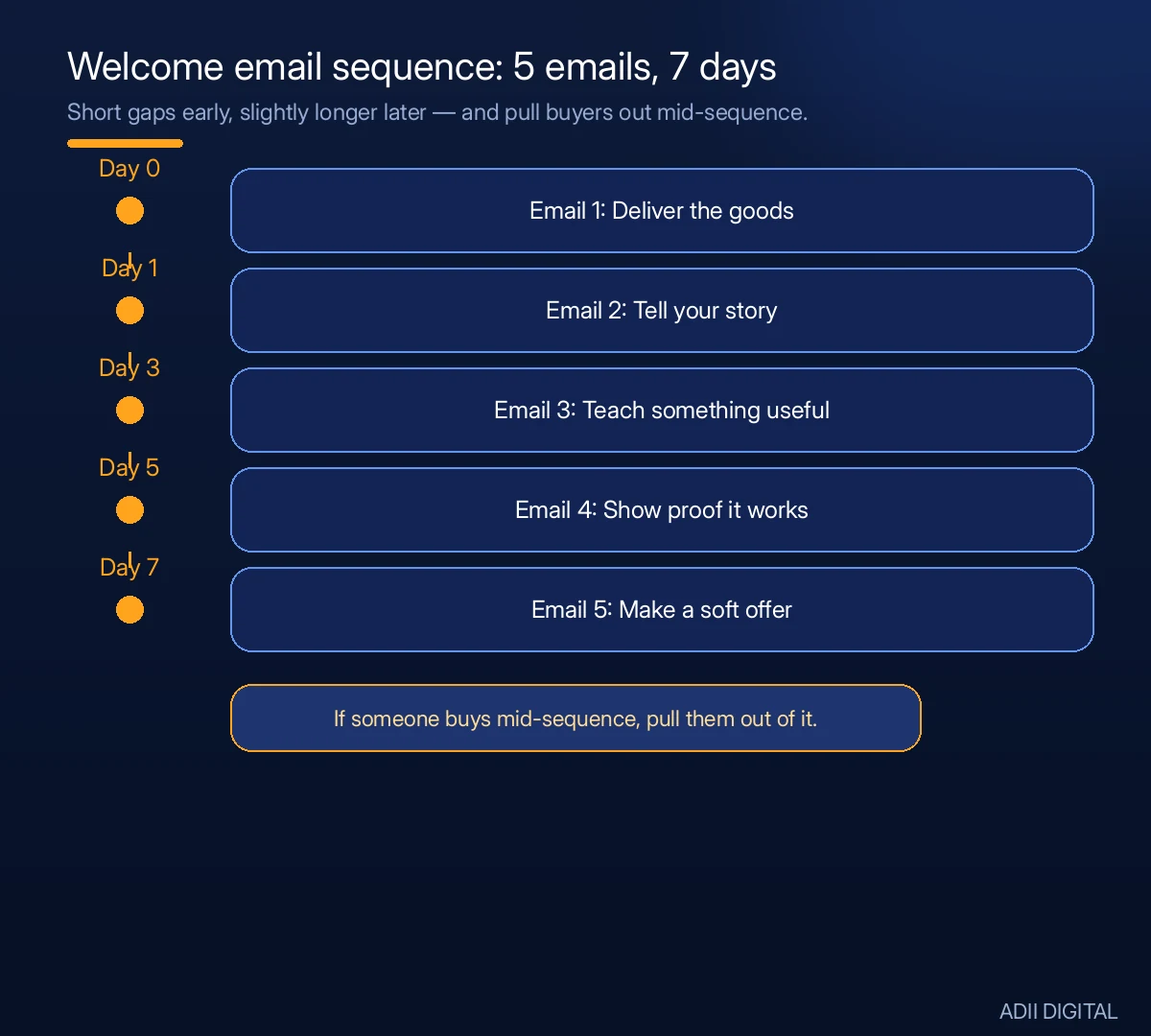
A strong welcome email sequence has five emails: deliver the promised value right away, share your story so subscribers connect with you, teach something useful, show proof that your approach works, and then make a soft offer. Space the emails over about a week — day 0, day 1, day 3, day 5, and day 7 — and keep each email focused on one clear message.
Welcome emails tend to see strong open rates, because the reader has just asked to hear from you. Someone just raised their hand and said “yes, I want to hear from you.” That attention fades fast, so the sequence you send in the first week matters more than any single campaign later. Here’s how to write one that builds trust and gently leads toward a sale.
In This Article
- What Is a Welcome Email Sequence?
- Email 1: Deliver the Goods (Day 0)
- Email 2: Tell Your Story (Day 1)
- Email 3: Teach Something Useful (Day 3)
- Email 4: Show Proof It Works (Day 5)
- Email 5: Make a Soft Offer (Day 7)
- How Do I Time and Set Up the Sequence?
- What Mistakes Should I Avoid?
- Frequently Asked Questions
- How many emails should a welcome sequence have?
- How long should I wait between welcome emails?
- Should every subscriber get the same welcome sequence?
- What if someone doesn’t open the welcome emails?
- Can I include a discount in my welcome sequence?
What Is a Welcome Email Sequence?
A welcome email sequence is a short series of automated emails sent to new subscribers right after they join your list. If you are new to the channel, start with our guide on what email marketing is. Instead of one “thanks for signing up” email, you send four to six emails over several days that introduce who you are, deliver value, and build a relationship.
Most email marketing platforms (Mailchimp, ConvertKit, ActiveCampaign, Klaviyo, and others) have automation builders where you can set this up once and let it run for every new subscriber.
Email 1: Deliver the Goods (Day 0)
Send this immediately after signup. Its only job is to deliver what you promised — the discount code, the free guide, the checklist, whatever got them to subscribe.
- Subject line ideas: “Here’s your 15% off code,” “Your free guide is inside,” “Welcome — here’s what you asked for”
- Keep it short. Deliver the thing at the top, in the first two lines, before any branding or chatter.
- Set expectations: tell them what they’ll get from you and how often. (“I’ll send you one practical marketing tip every Tuesday.”)
- End with a small invitation to reply. Ask a simple question related to their signup. Replies boost your sender reputation and give you real insight into your audience.
Template:
Subject: Your free SEO checklist is here
Hi there,
Thanks for signing up — here’s the SEO checklist I promised: [link]
Quick heads-up on what to expect: every Tuesday I’ll send you one practical tip to get more traffic, based on what’s working for my clients right now.
One question so I can make these emails more useful for you: what’s the biggest thing holding back your website traffic right now? Just hit reply — I read every response.
Talk soon,
Sarah
Email 2: Tell Your Story (Day 1)
Now that they’ve got the goods, introduce yourself like a person, not a brand. People buy from people they feel they know.
- Share your origin in a few short paragraphs. What problem did you run into? What did you figure out? Keep it honest and specific — “I spent two years sending emails nobody opened” beats “we’re passionate about excellence.”
- Connect your story to their problem. End the story where their journey begins: “That’s why I started sending these emails — so you don’t have to learn it the hard way.”
- Include one photo of yourself if you can. It makes the email feel personal and stands out in a crowded inbox.
- Keep the pitch out of this one. No selling yet. You’re building a connection.
Subject line ideas: “How I learned this the hard way,” “A quick story about why I do this,” “The mistake that started it all”
Email 3: Teach Something Useful (Day 3)
Give them a genuine win. Share your best practical advice — the kind of tip they’d normally have to pay for. This email proves your expertise better than any credentials page.
- Pick one specific, actionable lesson. Not “five vague tips” — one thing they can do today.
- Walk through it step by step, in plain language.
- Show a quick example or result from your own experience. (“When I changed this subject line, replies doubled” is fine — just keep it to things that actually happened.)
- End with a question or a small challenge: “Try this on your next email and tell me how it goes.”
Subject line ideas: “The 10-minute fix for low open rates,” “Try this before your next send,” “One trick that changed my results”
This is the email people forward to friends. Make it your best one.
Email 4: Show Proof It Works (Day 5)
By now they like you and they’ve learned something. This email answers the quiet question: “Does this actually work for people like me?”
- Share a customer story or result in story form. What was the situation before, what changed, what happened after.
- Use real specifics you can stand behind — and decide in advance how you will judge the sequence; our guide to understanding digital ROI covers the basics — never invent numbers, names, or testimonials. If you’re new and don’t have client results yet, share your own results or a detailed lesson from your own work.
- One story per email. Don’t cram three case studies into one message.
- You can softly mention your product or service here as the thing that made the result possible, but keep the story as the star.
Subject line ideas: “How one business fixed its email problem in 2 weeks,” “Real results, real people,” “This is why I do what I do”
Email 5: Make a Soft Offer (Day 7)
Now you’ve earned the right to ask. This email introduces your product or service as the natural next step — not a hard pitch, more like a helpful suggestion.
- Remind them of the problem you’ve been talking about all week, then present your offer as the shortcut.
- Be specific about what they get and what happens next. Remove the mystery: what it costs, how it works, what the first step is.
- Address the main objection head-on. If people usually hesitate on price, explain the value. If they hesitate on time, explain how little it takes.
- Include a clear call to action — one link, one button. Keep the wording short and direct; our web copywriting essentials guide has more on writing copy that gets a click. Don’t give them three options.
- If you run a guarantee or a trial, mention it. It lowers the risk of saying yes.
Subject line ideas: “Ready when you are,” “The shortcut I mentioned,” “Here’s how I can help (if you want it)”
Template:
Subject: Ready when you are
Hi there,
Over the past week I’ve shared how I fixed my own email deliverability, the 10-minute check I use before every send, and how to show proof that your approach works.
If you want me to just handle it for you — the setup, the copy, the whole system — that’s exactly what I do for clients. Here’s how it works: [link]
No pressure either way. The tips I’ve sent you this week will keep working whether or not we ever talk again.
Cheers,
Sarah
How Do I Time and Set Up the Sequence?
Timing matters almost as much as copy. A few rules that work well:
- Send email 1 instantly. Waiting even an hour kills the momentum of a fresh signup.
- Keep the gaps short early and slightly longer later: day 0, day 1, day 3, day 5, day 7 works well for most businesses.
- If someone buys or books a call mid-sequence, pull them out of it. Nothing is more awkward than receiving email 5’s pitch after you’ve already purchased.
- For ecommerce, you can compress this to 3-4 emails over 3-4 days — shoppers decide faster. For B2B or services, the full week (or even 10 days) gives people time to think.
- Test one thing at a time: subject lines first, then timing, then the offer — and keep the tests inside your wider email marketing strategy so each sequence supports the same goal. Change everything at once and you’ll never know what worked.
What Mistakes Should I Avoid?
- Selling in email 1. The fastest way to get unsubscribes is pitching before you’ve given anything.
- Writing essays. Each email should make one point. If it’s longer than a screen or two on a phone, cut it.
- Sounding like a corporation. “We are excited to announce” is the fastest way to sound like everyone else. Write like you talk.
- Skipping the reply invitation. Welcome sequences are your best chance to start real conversations. Use it.
- Forgetting mobile. Most of your subscribers will read on a phone. Short paragraphs, one clear link, readable font size.
Related guides: Email Marketing for Consultants · Best Email Marketing Software for Small Business
Frequently Asked Questions
How many emails should a welcome sequence have?
Five is the sweet spot for most businesses — enough to build trust and make an offer without wearing out your welcome. Ecommerce stores can do well with three or four; high-ticket services sometimes stretch to six or seven.
How long should I wait between welcome emails?
Send the first one immediately, then space the rest over 5 to 10 days. Day 0, 1, 3, 5, 7 is a reliable default. Shorter gaps work for ecommerce; slightly longer gaps suit B2B.
Should every subscriber get the same welcome sequence?
Not necessarily. If you have very different audiences — say, buyers and blog readers — consider a separate, shorter sequence for each. The closer the sequence matches why they signed up, the better it performs.
What if someone doesn’t open the welcome emails?
Don’t panic, and don’t resend the whole thing. Most platforms let you add a simple branch: if someone hasn’t opened email 2 after a day or two, try a different subject line once. Beyond that, let them flow into your regular emails.
Can I include a discount in my welcome sequence?
Yes, and it works well for ecommerce. Put the discount in email 1 (it’s what they signed up for) and remind them once more in the final email before it expires. For services and B2B, a free consultation or audit usually converts better than a discount.
A good welcome sequence can keep working for you around the clock: it delivers value, tells your story, teaches something real, shows proof, and then makes a natural offer. If you’d rather have a professional write and set up the whole thing, check out our digital marketing services — email sequences are one of our favorite things to build.